Post-Disaster Education to Be Strengthened with the International REACT Academy Project


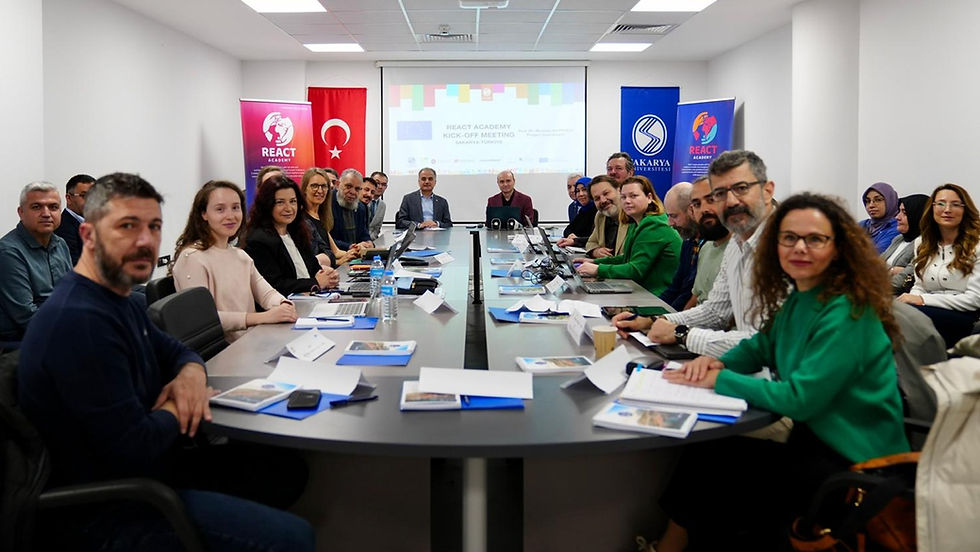
The kickoff meeting of the REACT Academy Project, supported by the European Union and coordinated by Sakarya University, has been held. The meeting, hosted by Sakarya University, brought together academics and researchers from six different countries.
With the launch meeting of REACT Academy— the highest-budget project led by the university—project activities have officially begun.
The meeting was attended by Sakarya University Rector Prof. Dr. Hamza Al, Vice Rectors Prof. Dr. Mehmet Barış Horzum and Prof. Dr. Halit Yaşar, Dean of the Faculty of Education Prof. Dr. Hüseyin Çalışkan, Erenler District Director of National Education Ayhan Ersoy, Branch Manager Bedir Bayram, and Project Coordinator Prof. Dr. Mustafa Bayrakcı.
Supported under the Erasmus+ Teacher Academies program and set to run for 36 months, the project titled “Resilience Empowerment for Adaptation Capacity of Teachers in Post-Disaster Sustainability of Education – REACT Academy” aims to enhance the professional capacities of teachers and teacher candidates to ensure the continuity of education during disasters and crisis conditions.

The project consortium coordinated by Sakarya University includes the following institutions:
Università degli Studi di Roma La Sapienza (Italy)
Högskolan Kristianstad (Sweden)
Wyższa Szkoła Biznesu i Nauk o Zdrowiu (Poland)
Casa do Professor (Portugal)
Directorate of Primary Education of Crete (Greece)
Erenler District Directorate of National Education (Türkiye)
In his speech, Prof. Dr. Hamza Al emphasized that Sakarya University is a leading higher education institution in Türkiye, distinguished by its achievements in research, development, and education. He also noted that the university has recently advanced its success further by gaining the status of a “Research University.”
Project Coordinator Prof. Dr. Mustafa Bayrakcı stated that they have felt strong support from the university administration throughout all phases of the project, including design, preparation, and implementation. He underlined that such institutional support is crucial for developing new project initiatives.
To ensure that the knowledge produced within the scope of REACT Academy extends beyond the project duration, special emphasis will be placed on open access, digital visibility, institutional ownership, and sustainable dissemination strategies. In this context, the project is expected to make lasting contributions in areas such as teacher education, resilience in education, the restructuring of post-disaster learning processes, and the development of education policies.


Comments